
Holy Thursday, also called Maundy Thursday, is one of the most symbolically rich days in the entire Christian calendar. Every ritual performed, every object placed on the altar, and every gesture made during Holy Week carries a deep, layered meaning.
Whether you’re a lifelong Catholic, a curious seeker, or a student of Christian traditions, understanding these Holy Thursday symbols unlocks the full spiritual depth of the Last Supper.
This guide walks you through the most powerful symbols of Holy Thursday, their biblical roots, their cultural expressions, and what they mean for believers today.
What Are Holy Thursday Symbols?
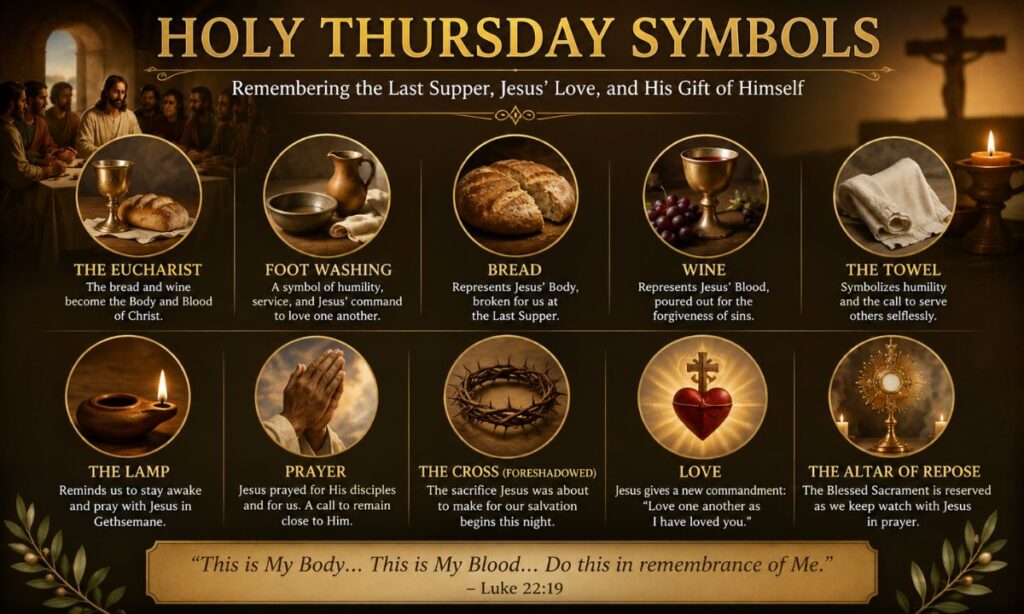
Holy Thursday symbols are sacred objects, rituals, and images that represent the events of the Last Supper and the night before Jesus’ crucifixion. These symbols — from the bread and wine to the basin and towel — make abstract theological truths visible and tangible for worshippers across generations and denominations.
The word “Maundy” itself is a symbol. It comes from the Latin mandatum, meaning “commandment,” referring directly to Jesus’ words in John 13:34: “A new commandment I give you: love one another.” That single word encapsulates the entire meaning of the day.
Holy Thursday Meaning and Symbolism
Holy Thursday Meaning
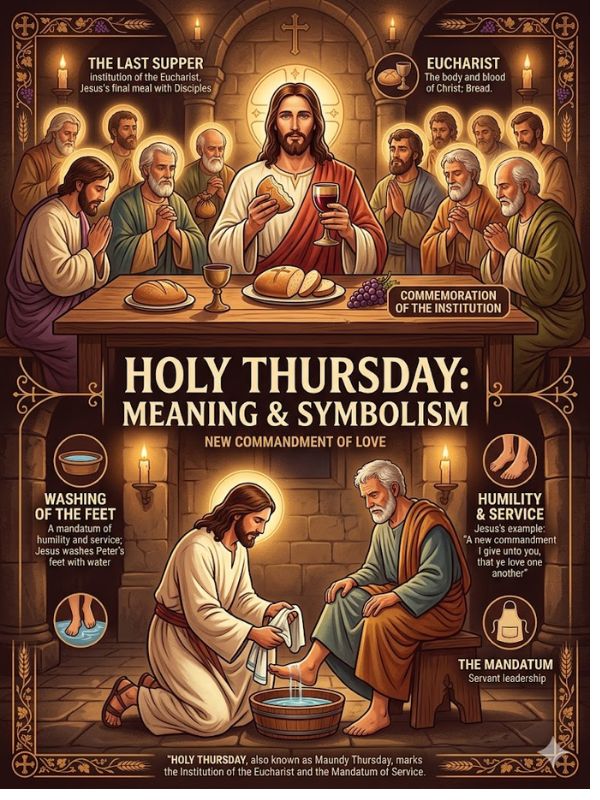
Holy Thursday marks the Thursday before Easter — the fifth day of Holy Week. It commemorates three pivotal events:
- The Last Supper — Jesus’ final Passover meal with his twelve disciples
- The Washing of Feet — Jesus’ act of servant humility
- The Institution of the Eucharist — the origin of Christian communion
Together, these events form the theological foundation of Christian worship. The day begins the Paschal Triduum, a three-day observance ending on Easter Sunday that commemorates the passion, death, and resurrection of Christ.
Thursday Symbolism
Thursday itself carries symbolic weight in the Christian tradition. As the eve of the crucifixion, it represents the tension between intimacy and betrayal, between love freely given and trust broken. The Thursday gathering in the upper room was both the warmest and the most painful meal in recorded scripture.
Happy Holy Thursday — What the Day Is Actually About
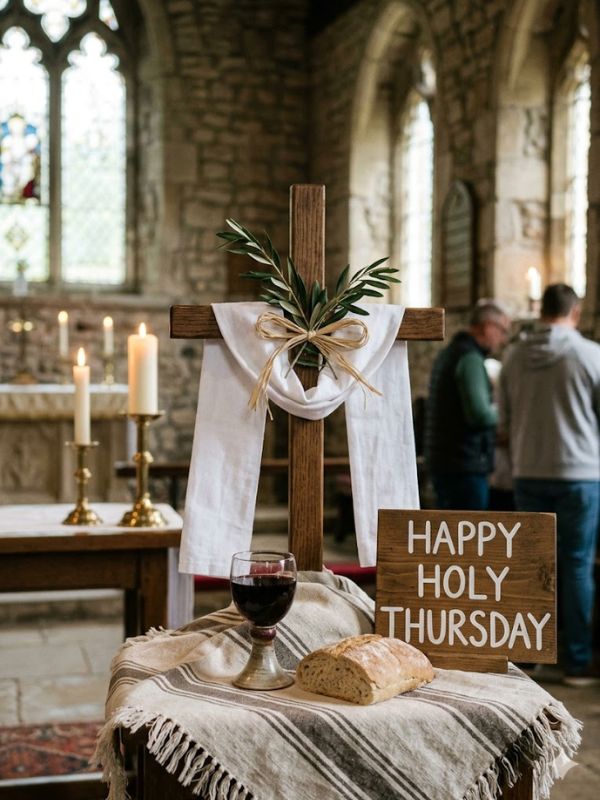
Despite the solemnity, Holy Thursday is not purely mournful. Many Christians greet one another with a sense of reverent joy on this day, because the Last Supper represents Christ’s gift of himself — freely, lovingly, and eternally.
The celebration of the Eucharist that night was an act of profound generosity. “Happy Holy Thursday” reflects that the day is as much about love and connection as it is about sacrifice.
Maundy Thursday Symbols Explained
Here is a breakdown of the core Maundy Thursday symbols, what they are, and what they mean:
| Symbol | Object / Action | Spiritual Meaning |
| Bread | Unleavened loaf | Body of Christ; sustenance; unity |
| Wine / Chalice | Cup of red wine | Blood of Christ; covenant; sacrifice |
| Basin & Towel | Water basin + cloth | Humility; servant leadership; purification |
| Twelve Disciples | The apostles | Community; the church; human fallibility |
| Stripped Altar | Bare altar table | Desolation; Christ’s vulnerability; preparation for death |
| Oil (Chrism) | Holy anointing oil | Healing; consecration; spiritual strength |
| Candles | Flame and light | Christ as the light of the world |
| Passover Lamb | Symbolic meal element | Jesus as the Lamb of God; sacrifice |
| Upper Room | The Cenacle | Intimate community; the birth of the Church |
| Judas’ Empty Seat | The betrayer’s place | Human weakness; the weight of betrayal |
Types and Variations of Holy Thursday Symbols
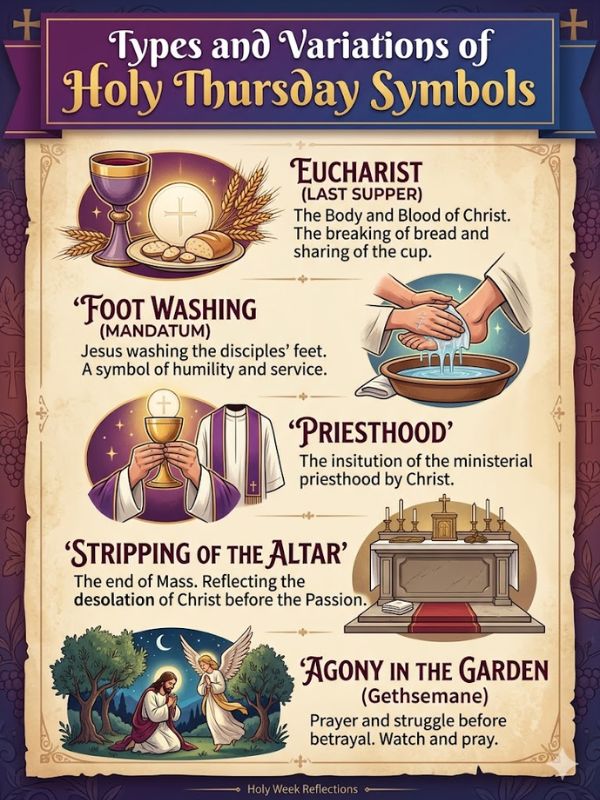
The Bread and Wine
No symbols define Holy Thursday more than bread and wine. When Jesus broke bread and shared the cup, he told his disciples: “This is my body… this is my blood of the covenant” (Matthew 26:26–28).
- Bread represents nourishment, shared humanity, and the body of Christ broken for the world
- Wine symbolizes the blood poured out as a new covenant between God and humanity
- Together, they form the basis of the Eucharist, the central sacrament of Christianity
Across Catholic, Orthodox, Lutheran, Anglican, and Methodist traditions, these elements remain the most universally recognized Last Supper symbols.
The Basin and Towel
Perhaps the most striking symbol of Holy Thursday is Jesus kneeling before his disciples with a basin of water and a towel (John 13:3–5). In first-century Palestine, foot-washing was the task of the lowest servant. For a rabbi and teacher to wash the feet of his students was an act that turned social hierarchy completely upside down.
- The basin symbolizes cleansing, humility, and readiness to serve
- The towel represents the servant’s role — the clothing of love in action
- Together, they embody servant leadership, one of Christianity’s most radical teachings
Also Read this Symbol Meaning 7 Symbols of Virgo
The Chalice
The chalice — the cup used at the Last Supper — is one of the oldest and most recognizable Christian symbols. In liturgical art, the chalice often appears alongside the host (bread), symbolizing the full Eucharistic mystery. The chalice also connects to Christ’s prayer in Gethsemane: “Father, if it is your will, take this cup from me” (Luke 22:42), linking it to both the sacrament and the coming sacrifice.
The Twelve Disciples
The number twelve is deeply symbolic in scripture — twelve tribes of Israel, twelve apostles. At the Last Supper, Jesus gathered all twelve, knowing one would betray him. This symbol speaks to:
- The wholeness of the community Christ gathered
- The reality of human weakness (Judas, Peter’s denial)
- The universal mission of the church
In many Catholic Holy Thursday services, the priest ceremonially washes the feet of twelve people, directly recalling this symbolism.
The Stripped Altar
At the end of the Holy Thursday Mass, the altar is stripped bare — candles removed, cloths taken away, tabernacle emptied. This powerful act symbolizes:
- The stripping of Christ before his crucifixion
- The desolation and grief of the disciples
- The church entering into a posture of mourning and waiting
The stripped altar remains bare through Good Friday and Holy Saturday, serving as a visual reminder of the Passion.
Holy Thursday Symbols Across Cultures
Different cultures and Christian communities have developed their own expressions of Holy Thursday symbolism:
- Germany calls it Gründonnerstag (Green Thursday), where green herbs symbolize renewal and the completion of Lenten penance
- United Kingdom observes the Royal Maundy service, where the monarch distributes special coins (Maundy money) in red and white purses — symbols of charity and royal service
- Philippines features an elaborate Visita Iglesia, where pilgrims visit seven churches, with each stop representing a station of prayer
- Eastern Orthodox traditions include the blessing of holy chrism oil, used for baptism and anointing throughout the year
- Latin America combines foot-washing rites with community meals, emphasizing the social justice dimension of servant leadership
Holy Thursday Symbols in Art, Movies, and Pop Culture
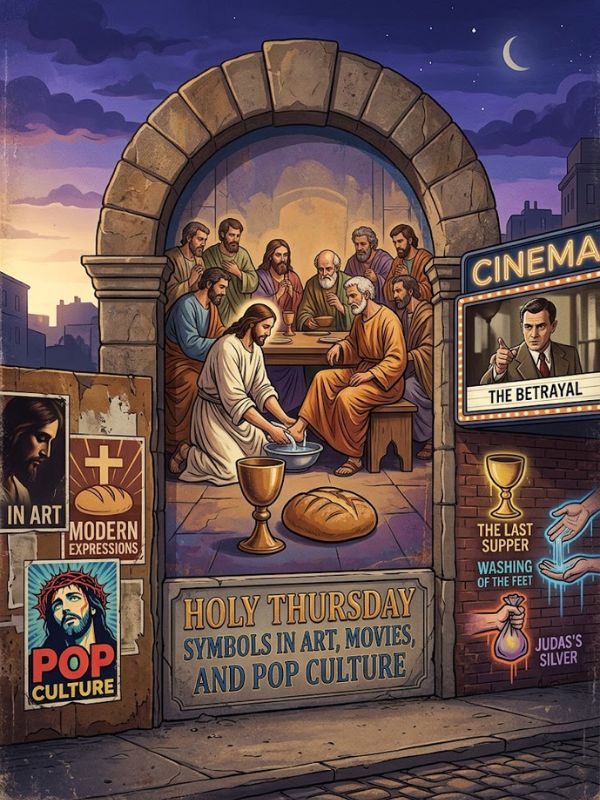
Leonardo da Vinci’s The Last Supper (1495–1498) remains the most iconic visual interpretation of Holy Thursday. Every element in the painting — the bread, the wine, the arrangement of the disciples, the central figure of Christ — draws on centuries of symbolic tradition.
Holy Thursday imagery appears in:
- Stained glass windows in Gothic cathedrals, where bread, chalice, and lamb motifs dominate
- Films like The Passion of the Christ (2004), which depicts the Maundy Thursday events with intense symbolic detail
- Literature, from Dante’s Divine Comedy to Graham Greene’s The Power and the Glory, where Eucharistic symbolism carries moral weight
- Music, including Bach’s St. Matthew Passion, which musically dramatizes the Last Supper and its aftermath
Spiritual and Dream Meaning of Holy Thursday Symbols
In Christian spiritual tradition, Holy Thursday symbols carry personal, interior meaning:
- Dreaming of bread or wine is often interpreted as a call to deeper communion — with God, with community, or with one’s own conscience
- Water and washing symbolize the soul’s need for purification and the willingness to serve others without ego
- The chalice in dreams may represent sacrifice willingly embraced, or a challenge being accepted with grace
Spiritually, Holy Thursday invites believers to ask: Am I willing to kneel before others? Am I willing to be nourished and to nourish?
Also Read This Symbol meaning Powerful Symbol of Life
Positive vs. Negative Meaning of Holy Thursday Symbols
| Symbol | Positive Meaning | Shadow / Negative Meaning |
| Bread | Unity, generosity | Taken for granted; broken trust |
| Wine | Covenant, joy | Betrayal (Judas dipped his bread in the dish) |
| Foot Washing | Servant leadership | Resistance to receiving love (as Peter initially refused) |
| Twelve Disciples | Community strength | Abandonment, denial, betrayal |
| Stripped Altar | Honest grief | Desolation, spiritual emptiness |
Why Are Humans Drawn to Holy Thursday Symbols?
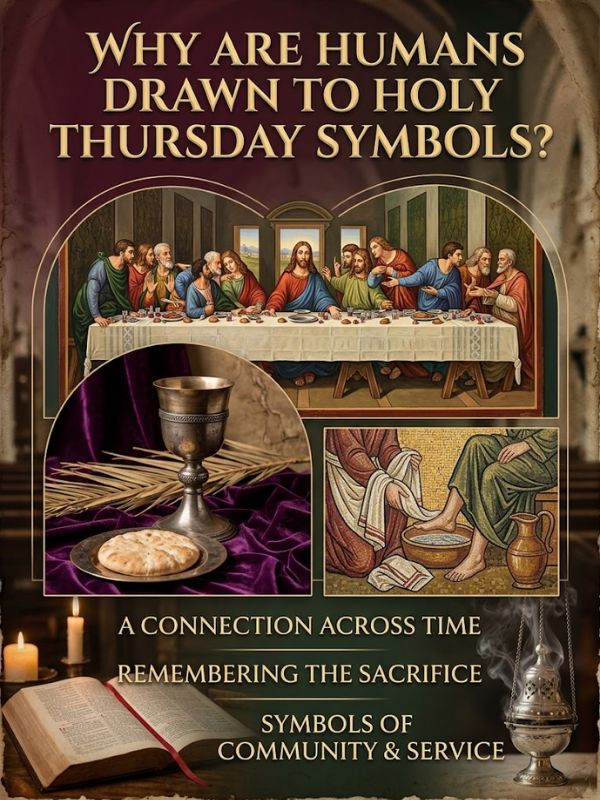
Symbols speak where words fail. Holy Thursday symbols endure across two millennia because they touch universal human experiences:
- Sharing a meal is one of the most primal acts of human community
- Kneeling to serve challenges every instinct toward power and pride
- A final gathering resonates with anyone who has faced loss or farewell
- The cup of suffering is something every human eventually holds
These symbols also make the invisible visible — love, sacrifice, betrayal, covenant, and hope are abstract concepts. A broken loaf of bread, a basin of water, a bare altar: these make those truths undeniable and immediate.
Conclusion
Holy Thursday symbols are not decorative relics of ancient religion — they are living, breathing expressions of Christianity’s most radical claims: that love is expressed through service, that the sacred is found in a shared meal, and that even betrayal and death cannot end the covenant between the divine and the human.
From the bread and wine of the Eucharist to the basin and towel of foot washing, from the chalice to the stripped altar, each symbol invites believers to enter more deeply into the story that changed history. Whether you observe Holy Thursday in a cathedral, a small chapel, or quietly at home, these symbols speak across centuries with the same urgent, tender message: Love one another.
